What Are AI Agents?
AI agents are autonomous systems that can perceive their environment, make decisions, and take actions to achieve specific goals. Unlike traditional chatbots that follow scripted flows, modern AI agents leverage large language models to reason about complex problems, break them into steps, and execute multi-step workflows.
The key difference: agents act, they don't just respond. They can call APIs, query databases, send emails, process documents, and make decisions, all without human intervention for routine tasks.
Why Businesses Are Adopting Agents Now
Three converging factors have made 2025 the inflection point for enterprise AI agents:
-
LLM capabilities have matured: Models like GPT-4, Claude, and open-source alternatives can reliably reason about business logic, follow instructions, and handle edge cases.
-
Tool-use frameworks are production-ready: LangChain, CrewAI, and custom orchestration layers make it straightforward to give agents access to your existing tools and APIs.
-
The ROI is measurable: Early adopters are reporting 40-60% reductions in manual processing time for document-heavy workflows, with payback periods measured in weeks, not years.
Real-World Use Cases
Customer Support Triage
Instead of routing every support ticket to a human, an AI agent can read the ticket, classify severity, pull relevant customer history from your CRM, and either resolve the issue directly or route it to the right specialist with full context. We built this for a SaaS client and it reduced first-response time from 4 hours to under 2 minutes.
Document Processing Pipelines
Insurance claims, medical records, legal contracts: any document-heavy workflow can benefit from an agent that extracts structured data, cross-references it against business rules, and flags exceptions for human review. The agent handles the 80% of routine cases; humans focus on the 20% that need judgement.
Sales Intelligence
Agents that monitor competitor pricing, track industry news, and generate weekly briefings for sales teams. They pull from multiple data sources, synthesize the information, and deliver actionable insights, not just raw data dumps.
Building Your First Agent: What to Know
Start with a narrow scope
The most successful agent deployments target a specific, well-defined workflow. Don't try to build a general-purpose assistant. Pick one process that's high-volume, rules-based, and currently handled manually.
Design for human-in-the-loop
No agent should operate without oversight, especially in the early stages. Build escalation paths, confidence thresholds, and audit trails into every agent. When the agent isn't sure, it should ask, not guess.
Measure before and after
Document the current state: how long does the process take? How many errors occur? What's the cost per transaction? These baselines are what make the ROI case undeniable three months later.
The Architecture Pattern
A production AI agent typically consists of:
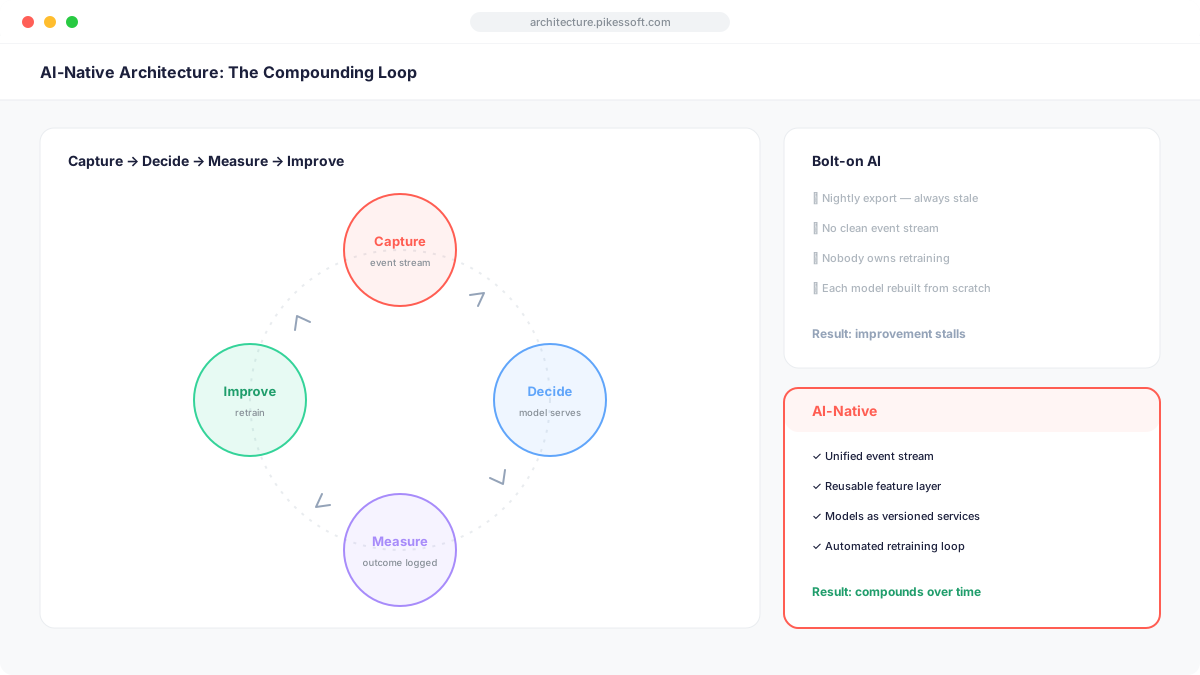
User Input → Orchestrator → LLM (reasoning) → Tool Selection → Action Execution → Response
                  ↑                                                    |
                  └────────── Memory / Context Store ←─────────────────┘
The orchestrator manages the loop: it sends the current state to the LLM, the LLM decides which tool to use, the tool executes, and the result feeds back into the next reasoning step. This continues until the task is complete or the agent escalates to a human.
What's Next
The next wave of enterprise AI agents will be multi-agent systems, teams of specialized agents that collaborate on complex workflows. Think: one agent handles data extraction, another validates it, a third generates the report, and a supervisor agent coordinates the whole thing.
We're already building these systems for clients in healthcare, fintech, and logistics. The technology is ready. The question isn't whether to adopt AI agents. It's how quickly you can identify the right use case and start.
Need help building AI agents for your business? Let's talk.